Chat templates · Qwen
The Sharp system prompt: How a 1 tok/s model fixed Qwen 3.x
A model running at under a token a second taught me to make every token count. The system prompt I wrote for it now ships in the Sharp chat templates, and it gets Qwen to the answer faster without making it any less smart.
peculiar-ragdoll · · 3 min read
It started with a model I couldn’t really run. I downloaded Colibri, an engine that streams GLM-5.2’s experts from an SSD, and on my machine it managed less than one token a second. At that speed every word costs you. A paragraph of pleasantries is a coffee break, and a chain of thought that wanders is a lost afternoon.
I wanted to see how useful I could make it anyway. So I wrote a system prompt with one goal: use as few tokens as possible and put what matters first, without giving up any intelligence or any nuance that matters. Skip the hedging and the niceties. Lead with the answer, then give only what it needs to be complete and correct.
It travelled
It worked, and not just on GLM. The same prompt tightened up model after model that had messy, wordy answers and meandering chains of thought.
My favourite family was Qwen, and the timing was good. froggeric’s fixed Qwen chat templates keep the model’s reasoning from earlier turns by default, so it remembers what it thought instead of starting over each turn. Kept reasoning costs context, though, so it pays off most when the reasoning is short, and short reasoning is exactly what the prompt gives you. I started with my favourite terse-reasoning Qwen fine-tune, ThinkingCap-Qwen3.6-27B, and moved on to other Qwen models from there.
What it says
The prompt is appended after your own system prompt, never in place of it. In short:
- never open with preamble or pleasantries, restate the question, add filler transitions, hedge with niceties, or repeat a point
- always keep the essential steps, caveats, uncertainties and specifics: brevity never wins over correctness or a needed warning
- use the least structure that carries the answer, and if a request is genuinely ambiguous, ask one sharp question instead of guessing
What it did
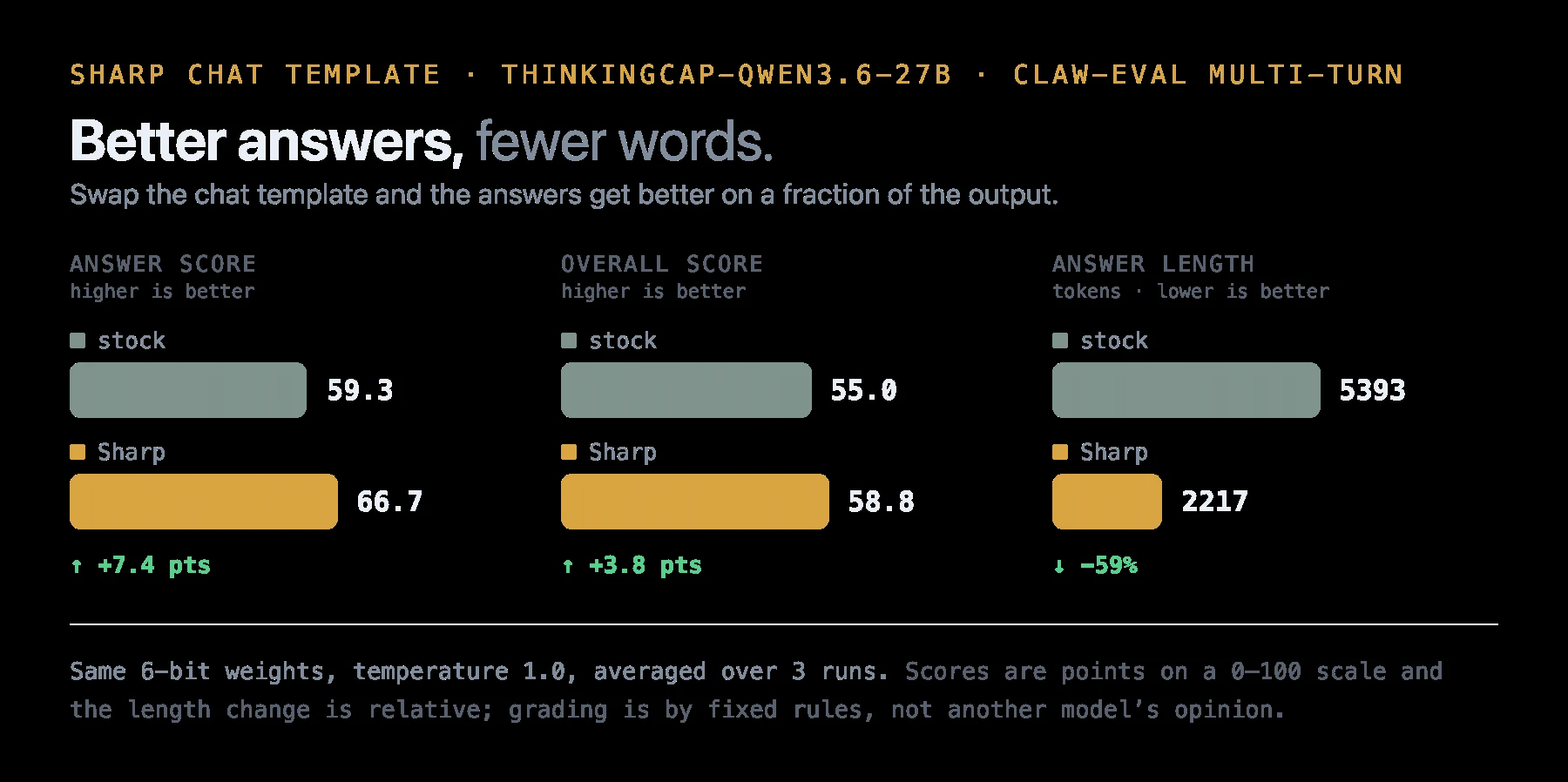
Better answers in less than half the words:
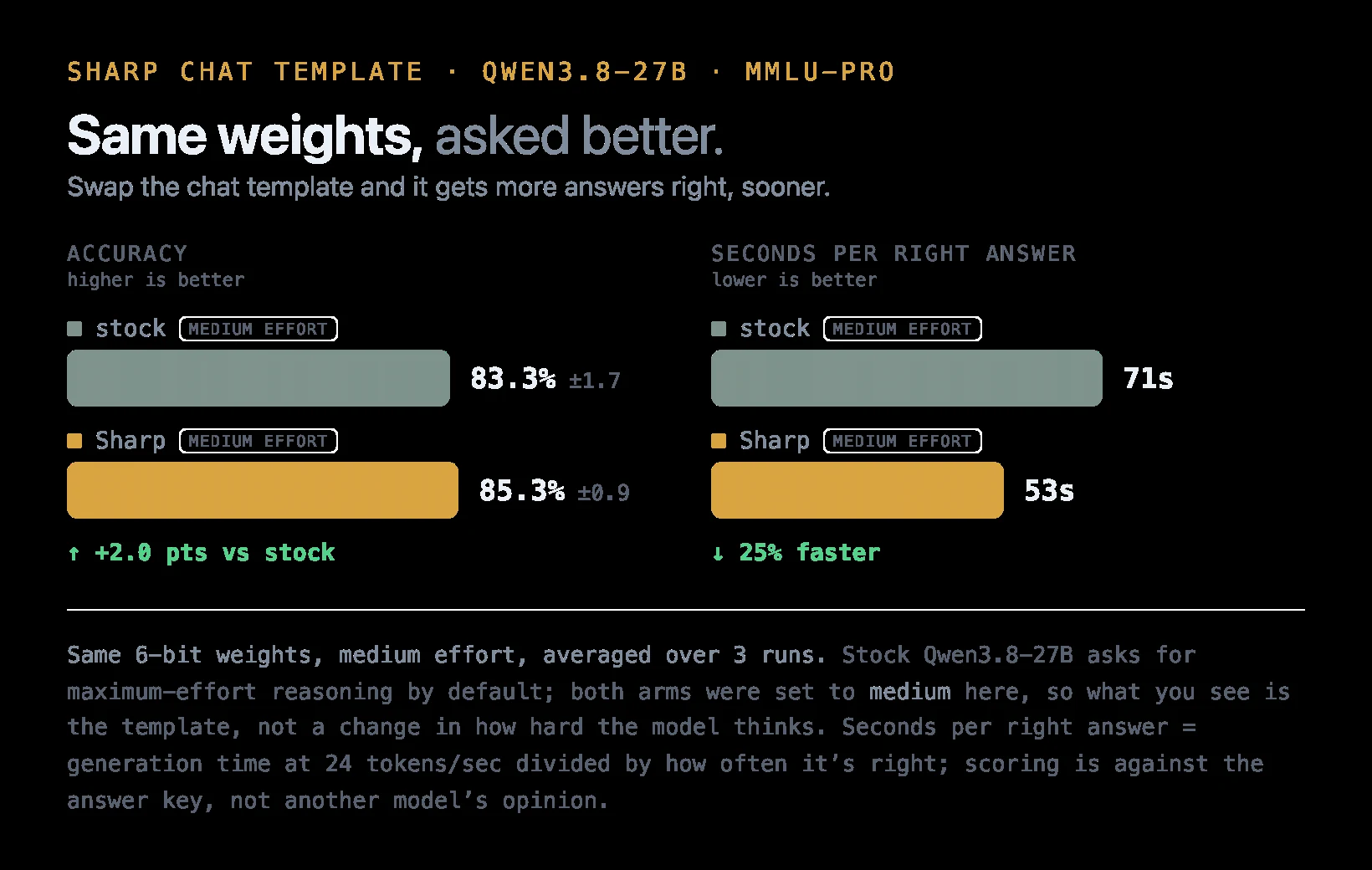
More answers right, sooner:
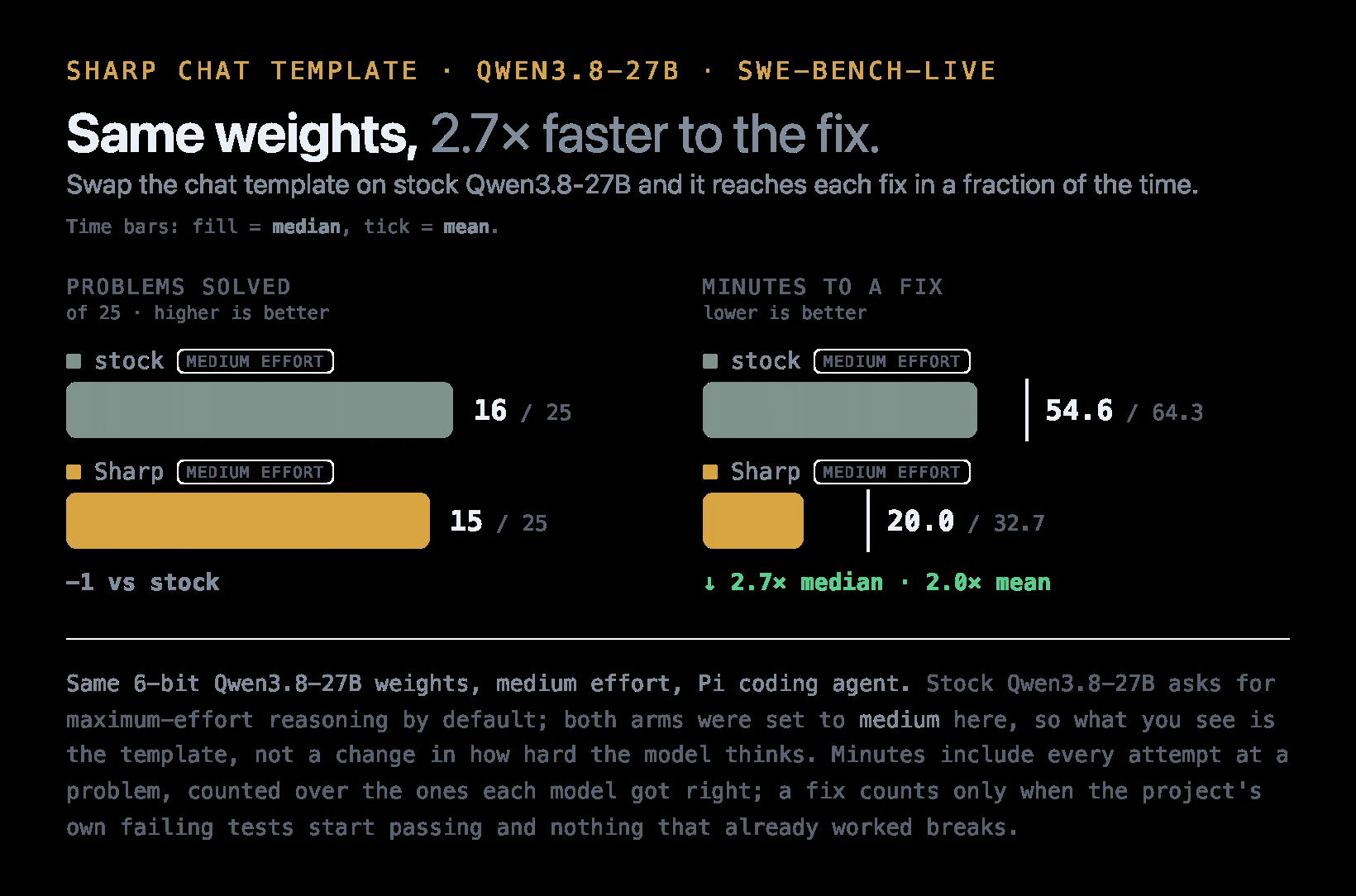
And on real repository work, about as many fixes, reached far sooner: one fewer problem solved out of 25, but 2.7 times faster to a fix on the median problem.
Where it led
The prompt lives on in the Sharp chat templates, a drop-in for any Qwen 3.5, 3.6 or 3.8 model. It’s also what got me working on local models and publishing them on Hugging Face. They’ve passed six million downloads since, mostly Qwen models that ship with the Sharp template, quantized with dynamic imatrix calibration on curated corpora for agentic coding and security work.
All of that came from a model I could barely run.